Ikebana Workshop

Ikebana Workshop

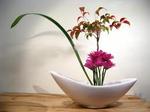
The word Ikebana comes from hireku, to make live, and from bana or hana, flower, vegetable. One could translate it as make flower live, bring the flowers to live.

The Ikebana practice brings us to the discovery of the vegetable world and its richness across the seasons: from the willow catkin in the Winter, to the maple leaf reddened by the first frosts in Autumn, passing by the spring cherry tree flowers or the bracken hidden in the shadows of a forest in Summer.

Waken your sensibility to the vegetable, to its beauty; that is the invitation that is coming to us from Japan.

Japanese Calligraphy

Japanese Calligraphy

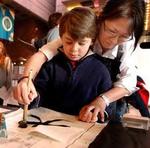
The Japanese calligraphy (Shodo) is one of the most popular fine arts of Japan. Calligraphical works are appreciated not less than products of painting. But this kind of the fine arts possesses also philosophical sense. In the simplest understanding the calligraphy is an art to write beautifully. The master creates a work of art by bamboo brush and inks on the rice paper. It transfers harmony and beauty. The parity of simple and graceful is embodied in calligraphical works as one of main principles of Japanese aesthetics wabi sabi.

There is nothing casual in Japanese calligraphy. The beginning, the direction, the form and the ending of lines, the balance between elements are important for each line and point, and even the empty space testifies about many things. The hieroglyphs are harmonious, proportional, balanced.

Manga Drawing Workshop

Manga Drawing Workshop

The AtelierU will organise several activities during the convention.

Follow drawing courses in order to get introduced to the secrets of the construction of a character or of the paintings, in order to discover an easy technique to colour your most beautiful illustrations. The courses will address the following topics:

Creation of a character: from the skeleton to the clothes. Material at your disposal: course material, sheets and pencils.

Coloured inks: introduction to the colouration techniques. Material at your disposal: brushes, inks and sheets. (maximum 15 people, registration on site)

Drawing contest will also be organised each day, with prices to win!!

Animated by an artist who graduated from the Ecole Cantonale d’Art du Valais, who has notably realised the poster of the 1st edition of the convention, these activities will be accompanied by course material and/or any necessary equipment.

Origami and Kirigami

Origami and Kirigami

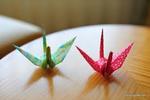
Origami (from oru meaning folding, and kami meaning paper) is the traditional Japanese art of paper folding. The goal of this art is to create a representation of an object using geometric folds preferably without gluing or cutting the paper, and using only one piece of paper.

The number of basic origami folds is small, but they can be combined in a variety of ways to make intricate designs. The most well known form is probably the Japanese paper crane. In general, these designs begin with a square sheet of paper whose sides may be different colors or prints. Contrary to most popular belief, traditional Japanese origami, which has been practiced since the Edo era (1603–1867), has often been less strict about these conventions, sometimes cutting the paper during the creation of the design - this is then called kirigami.

Shiatsu Massages

Shiatsu Massages

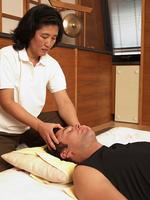
Shiatsu is the art of touch in the Oriental tradition. It litterally means: thumbs’ pressure.

It is a manual technique that is very popular in Japan, which consists in exercising pressions with fingers, palms, and sometimes elbows or knees on precise areas of the body. These areas correspond to the energy routes called meridiens, i.e. the subtle channels through which the vital energy (the Ki, in Japanese) flows and which constitute a link between the surface of the body and the inner organs.
Shiatsu also comprises a large variety of very soft articular mobilisations.

Shiatsu treatments are done on futons, and the jusha stays clothed (with loose clothes made in natural fibers if possible).

Zazen Meditation

Zazen Meditation

The word zazen comes from za, to sit, and zen, concentration, comprehension.

Zazen is a meditation where the goal is not to concentrate on a particular subject, but rather the fact to let loose one’s thoughts, sensations and emotions while practising a precise posture. The physical and psychic benefits of this practice are numerous:

- stress reduction
- immune system strengthening
- heart rate appeasement
- concentration increase
- etc.

The Clarens Dojo and the Zazen Group of Lausanne are partnering to make you levitate!!!