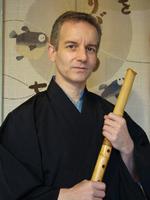

Ryo Fujimura

Ryo Fujimura

Ryo Fujimura is mainly known for being the leader, guitarist, author and compositor of the group AciD FLavoR, which distinguished itself in France through a tour and its Japan Expo 2008 participation. At the same time, Ryo developed several other misical activities, particularly the solo project Concrete. Two maxi-singles were edited in Europe, with promotion through roughly 20 dates across central Europe.

In 2010, AciD FLavoR ended its activities, after a 10 year career and a major contract with EMI Japan. Ryo Fujimura continued his solo activities. He signed the original soundtracks of several video games, such as Miyako, on PSP. He released a new digital single in Spring 2010.

 Musical Experience

Ryo Fujimura, who is known for his performances on the 7 cords guitar, though is originally a classic pianist. He started his piano training at the age of 3 years, age at which his family realised he had a perfect pitch, which made his musical training really short. He started guitar at the age of 17 years, and formed AciD FLavoR two years later. He was also the leader of the Visual Kei group, Syuten, today on a break. He started Concrete in 2008, with the will to leave behind the pop image and move in a more decisive manner towards a more rock and adult style.

Pinky Doodle Poodle

Pinky Doodle Poodle

Pinky Doodle Poodle, a pop-punk group based in Tokyo, was born from the encounter of the singer Yuria and the guitarist/compositor George Hattori. In 2008, they came together with the bassist Kayakki, and the group will then keep this composition. They work with a session drummer. Their sound is pop punk, punchy, swinging and at the same time cute, thanks to Yuria’s childish voice.

Yuria created Pinky Doodle Poodle after a really successful solo career. She signed, amongst other, the openings of Shuffle! (in which she is also Seiyuu), a really successful anime. She was also the leader of the group Honey Bee, with which she interpreted the openings of Gravion, Sumomomomomomo and Canvas 2.

The European version of their mini-album came out on the 15th of October 2009 across Europe and was followed by a European tour.

Taiko Concert

Taiko Concert

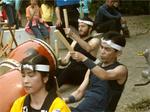
The first traces of taiko go back 2000 years, most likely brought back from Korea or China. At that time, these drums were used when asking the favour of the gods, such as asking for rain for the crop. Similarly to many other Japanese arts, it is during the Edo era, 400 years ago that taiko got more sophisticated. It became a military instrument used to motivate the troops during wars, but also an instrument used during festivals and rituals.

It is only been 50 years, after the 2nd World War, that taiko has become an entertainment music instrument. Japan wanted to revamp its cultural past at that time. Concerts, training courses, demos started developing. Rapidly, professional groups started playing on national and international stages. The famous Kodo taiko, for instance, only goes back about 25 years.

Shakuhachi Recital

Shakuhachi Recital

Shakuhachi, originating from China, made its first apparition in Japan in the Nara era, around the year 700. Rediscovered a few centries later, this bamboo flute became, with its soft and captivating tone, the prerogative of a traveling monk sect, the Komuso. Being a meditation instrument, its sound was meant to express the strength of the breath, and its melodies to explore the almost infinite timbres and sound colors of the instrument.

Thus, the player often only needs a single tone, which he modulates and ornaments in thousand ways, which he approaches and from which he moves away using the noise of the breath as well as the pure sound, of stable as well as glissandi tones, or abrupt changes. Some of these expression means used for several centuries are thus very close to the most avant-gardist techniques in Europe!!

Dieter Zuishô Nanz, flutist and musicologist, has given Shakuhachi concerts in Switzerland and Japan. He decided studying Shakuhachi in Japan with Kakiuchi Sanpô and Tajima Tadashi. The later, iemoto (founder) of Jikishô-Ryû and known worldwide as a major living ambassador of his art, gave him the title of Shihan (master) and invited Dieter Nanz to teach Shakuhachi in Europe.